 |
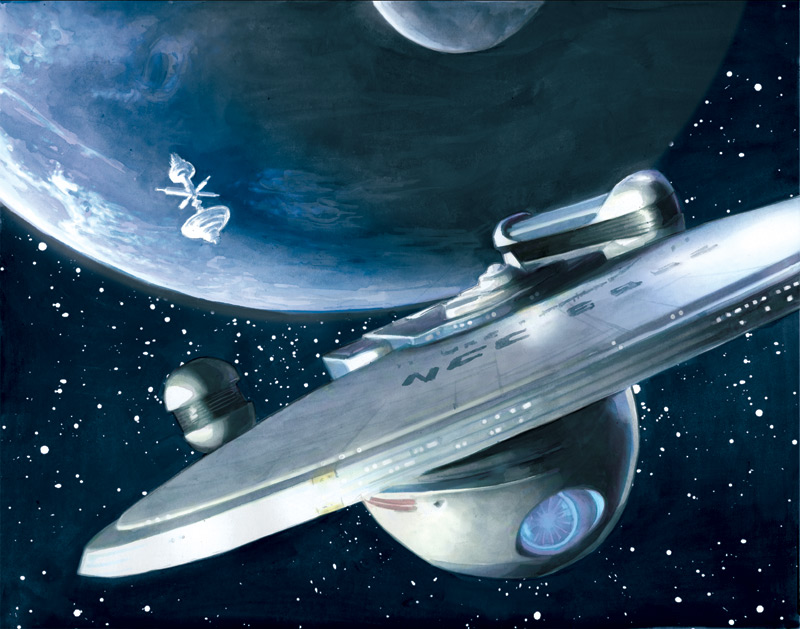
| The U.S.S. Cairo for the comic Captain's Log: Jellico, to be published soon by IDW. Art: JK Woodward |
The format of SciFi Art Now - out this October - is such that it promotes the art of the creators, but there's not much room to tell you more about them and their work. We're publishing interviews with creators here to redress the balance.
JK Woodward is comic book artist best known for illustrating the monthly series Fallen Angel, Fallen Angel: Reborn and Star Trek comics published by IDW Publishing (His most recent Trek story is Captain's Log: Pike, is on sale now). He's also illustrated covers and sequential work for Marvel, Top Cow, Devil's Due Press, Boom! Studios and Archaia.
SciFi Art Now: What tools do you mainly use to create your art?
JK Woodward: I work mostly in gouache. I paint a black and white value and then colourise it digitally. Occasionally, I'll work in the comic industry's more traditional pencil-and-ink and digital CMYK color method, but not often. You can see my process here [Facebook link - Ed].
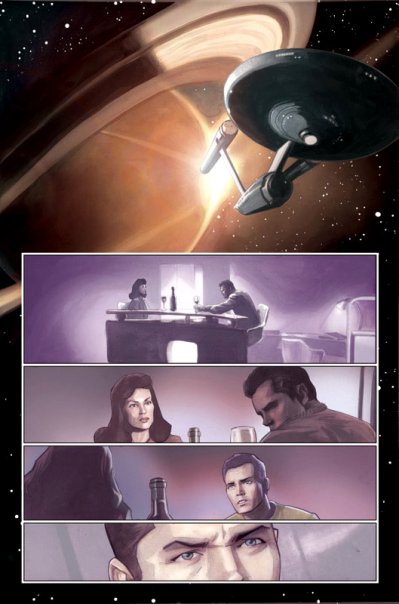 |
| The first page of IDW's Captain's Log: Pike - on sale in comic shops now |
JK Woodward: Well, I prefer oil, but gouache is a good, commercially viable substitute. It dries quick and can blend in much the same way as both oil and watercolour. So once you learn how to use it, it's kind of an all purpose medium.
I have two reasons for apply colour digitally. First, because a small tube of gouache can be very expensive, it's simply cheaper to buy only two tubes, black and white. Second, sometimes there are colour changes made by editors and I don't want to try to recreate a whole painting.
SciFi Art Now: What inspired you to become an artist?
JK Woodward: Science Fiction and comic books. I used to watch Creature Double Feature on UHF and Star Trek reruns as a kid. I used to like to draw the Godzilla monsters, the Enterprise, Cylon Warriors, and of course, Spider-Man. I used to watch those old Filmation reruns and it just inspired me to draw for hours. This eventually led me to other styles of art and other subject matters. I found myself drawn to mostly cubism and surrealism.
SciFi Art Now: What was the most useful piece of advice you were given when you began learning your craft?
 |
| The cover to Fallen Angel: Reborn #2 |
SciFi Art Now: Which artists most inspire you?
JK Woodward: It's so hard to say. I love Georges Braque, H.R.Giger, Frank Frazetta, Alex Ross, Bill Sienkiewicz, John Byrne, Alex Grey, Sorayama... They're all very different and they all influence who I've become as an artist.
SciFi Art Now: What is the appeal to you of science fiction as an inspiration for some of your work?
JK Woodward: It's the same as surrealism. It's based in realism, but not confined to it. It's imaginative, but it still has parameters.
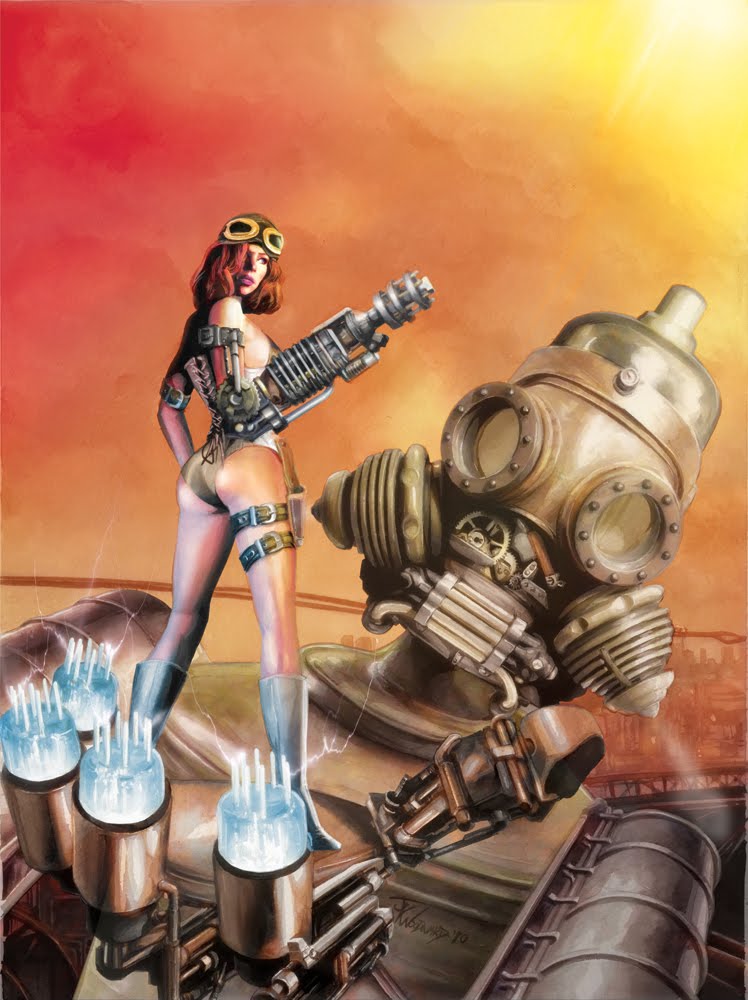 |
| 'Steam Witch' by JK Woodward |
JK Woodward: My favourite right now is a piece called 'Steam Witch'. It's a creation of mine, a steampunk adventure I concocted. I did it just for fun, but I have plans to publish it in the near future. I can't say any more about it at this time.
SciFi Art Now: In your career, have you had any bizarre experiences while creating your art?
JK Woodward: I'd been working for over 30 hours straight without sleep and very little to eat. I was working on a Fallen Angel splash page where a church was being blown up. I was extremely tired and the line between awake and asleep was beginning to blur. I must have lost consciousness for a second.
I remember opening my eyes and not knowing where I was, I panicked looking at the explosion and was halfway out of the studio when I realised I had looked at an image I had just painted.
At that point, I realised I needed to call it a day and get some sleep before I completely lose my mind...
SciFi Art Now: What most frustrates you about being an artist?
JK Woodward: The deadlines and the financial woes. Being an artist I notice that I either have time or I have money, but never both at once.
SciFi Art Now: What advice would you offer to anyone starting out as an artist?
JK Woodward: Get your work out there by any means necessary. I worked for three years with out making a cent, constantly publishing my work, before I started getting the money gigs. To succeed as a freelance illustrator will require sacrifice. If you think you're working too many ours, you're probably not working enough. Anything less than everything you've got is not enough to succeed in this business.


 in 2007, the 264-page collection features two infamous and hard-to-find collaborations with Eisner Award winner Grant Morrison: Dan Dare, a post-modern classic that sets the aging and retired iconic British character Dare against a modern British landscape he no longer understands; and Really and Truly, a high-octane psychedelic road-trip torn from the pages of cult comic 2000AD.
 (Amazon UK link), a survey of magazine artwork from the Swinging Sixties. Featuring over 1,000 gloriously inventive and stylistically diverse illustrations, it offers a fascinating insight into the extraordinary artistic talents of the illustrators featured, it also reveals the social aspirations of this unprecedented era of political optimism and sexual freedom.
 (Amazon UK link), also due for release in November, an overview of the astonishing artistic skill of the leading lifestyle illustrators of the period, revealing the changing social aspirations of the post-war generation and their growing optimism for the future.
 (Amazon UK link) is a celebration of the stunning and stylistically varied headline lettering that predated modern computer type. Each a unique one-off, custom hand-drawn lettering had a stylistic freedom and creative energy unfettered by traditional typographic rules and regulations.
