Showing posts with label Lee Moyer. Show all posts

Friday, 31 August 2012

John Picacio, Lee Moyer win Chelsey Awards

Congratulations are in order to SciFi Art Now cover artist John Picacio and artist Lee Moyer for their much-deserved 2012 Chelsey Award wins, given by the Association of Science Fiction and Fantasy Artists each year for excellence in genre art.

Lee secured Best Cover illustration for Weird Tales, Winter 2010/2011 above), while John won the Best Product Illustration category for his art in the George R.R. Martin: A Song of Ice and Fire 2012 Calendar published by Random House.

Congratulations to all the winners and nominees, who are all listed below and include another SFAN contributor, Jon Sullivan. Wonderful to see the late Jean Giraud, aka Moebius, was recognised for his work this year.

Check out the galleries on the ASFA web site - there's some terrific stuff to enjoy.

Best Cover Illustration: Paperback Book

ASFA Gallery

  • Winner: Matthew Stewart for The Cloud Roads by Martha Wells, Night Shade Books
  • Mitchell D. Bentley for The Alamo and Zombies by Jean A. Stuntz, Yard Dog Press, Dec. 2011
  • Dan Dos Santos for My Life as a White Trash Zombie by Diana Rowland, DAW Books (above)
  • Justin Gerard for Heart of Smoke & Steam by Andrew P. Mayer, Pyr Books
  • Lucas Graciano for The Goblin Corps by Ari Marmell, Pyr books
  • David Palumbo for God’s War by Kameron Hurley, Night Shade Books
  • Jon Sullivan for The Curious Case of the Clockwork Man by Mark Hodder Pyr Books
  • J. P. Targete for The Sword of Darrow by Alex & Hal Malchow, Ben Bella Books
Best Cover Illustration: Hardback Book
ASFA Gallery


  • Winner: Tom Kidd for Deathbird Stories by Harlan Ellison, Subterranean Press.
  • Stephan Martiniere for Prospero Regained by L. Jagi Lamplighter, Tor Books
  • Lee Moyer for Two Worlds and In Between: The Best of Caitlin R. Kieran, Subterranean Press
  • Cliff Nielsen for The Tempering of Men by Sarah Monette & Elizabeth Bear, Tor Books
  • Greg Staples for The Horror Stories of Robert E. Howard, Subterranean Press
Best Cover Illustration: Magazine
ASFA Gallery

  • Winner: Lee Moyer for Weird Tales, Winter 2010/2011
  • Facundo Diaz for Clarkesworld July 2011
  • Laura Diehl for Fantasy, August 2011
  • Carly B. Sorge for Apex Magazine, September 2011
  • Dariusz Zawadski for Fantasy, May 2011
Best Interior Illustration
ASFA Gallery

  • Winner: Julie Dillon for “The Dala Horse” by Michael Swanwick, Tor.com
  • Scott Gustafson for Eddie: The Lost Youth of Edgar Allan Poe by Scott Gustafson, Simon & Schuster
  • Ryohei Hase for “Narco Americano” by T. J. English, Playboy, February
  • Greg Staples for The Horror Stories of Robert E. Howard, Subterranean Press
  • J. P. Targete for The Sword of Darrow by Alex & Hal Malchow, BenBella Books
Best Monochrome Work: Unpublished
ASFA allery

  • Winner: Raoul Vitale for The Yeti, pencil
  • Justin Gerard for St. George and the Dragon, pencil
  • Stephen Hickman for Siegfried, ink on toned paper
  • Joāo Ruas for Migration, graphite on paper, vellum & acetate
  • Allen Williams for Wood Nymph, pencil
Best Color Work: Unpublished
ASFA Gallery

  • Winner: Omar Rayyan for The Dragon and the Nightingale
  • Stephen Hickman for The Hero of the Apotheosis
  • David Palumbo for Through a Blood Red Veil
  • Eric Velhagen for Fantasy Feast
  • Raoul Vitale for Turin and Glaurang
Best Three-Dimensional Art
ASFA Gallery

  • Tie Winner: Michael Parkes for Moonstruck, bronze
  • Tie Winner: Vincent Villafranca for Robobike, bronze
  • Gil Bruvel for Dichotomy, cupro nickel
  • Thomas S. Kuebler for Baba Yaga, mixed
  • Virginie Ropars for Autumnnalis Venenata, mixed (above)
Best Gaming-Related Illustration
ASFA Gallery

  • Winner: Michael C. Hayes for Distress, 2012 Core Set Magiccard,WotC
  • E.M. Gist for Wandering Elf, Magic the Gathering: Tactics, Sony Online
  • Lucas Graciano for Pathfinder Player Companion: The Humans of Golarian, Paizo Publishing
  • Chris Rahn for Glissa, the Traitor, “Mirrodin Beseiged” Magiccard,WotC
  • Matt Stewart for Creepy Doll, “Innistrad” Magic card, WotC
Best Product Illustration
ASFA Gallery


  • Winner: John Picacio for George R.R. Martin: A Song of Ice and Fire, 2012 Calendar, Random House, July 2011
  • Stuart Craig for production design for the Harry Potter films, Warner Brothers, 2011
  • Lee Moyer for Check These Out, 2012 Literary Pin-up calendar, Worldbuilders, 2011
  • William Stout for Zombies 2012, calendar, Andrews McMeel, 2011
  • Michael Whelan for Gift from the Sea, Dragon*Con 2011 promo art & program book, 2011
  • Michael Zug for IlluXCon 2011 promo poster, 2011
Best Art Director

Award for Lifetime Artistic Achievement


Friday, 21 January 2011

Lee Moyer delivers Lovecraft art for new author documentary

Watch more free documentaries
Sci-Fi Art Now contributor Lee Moyer has provided the art for a superb new documentary about the life of author HP Lovcraft, the forefather of modern horror fiction who has inspired such writers as Stephen King, Robert Bloch and Neil Gaiman.

The influence of Lovecraft's Cthulhu mythos can be seen in film (Re-animator, Hellboy, and Alien), games (The Call of Cthulhu role playing enterprise), music (Metallica, Iron Maiden) and pop culture in general.

But what led an Old World, xenophobic gentleman to create one of literature’s most far-reaching mythologies? What attracts even the minds of the 21st century to these stories of unspeakable abominations and cosmic gods?

Written and directed by Frank H. Woodward, Lovecraft: Fear of the Unknown is a chronicle of the life, work and mind that created these weird tales as told by many of today’s luminaries of dark fantasy including John Carpenter (The Thing), Guillermo Del Toro (Pan’s Labyrinth), Neil Gaiman (Coraline), Stuart Gordon (Re-Animator), Caitlin Kiernan (Daughter of Hounds) and Peter Straub (Ghost Story).

"This isn't  just a documentary about HP Lovecraft, but interviews with many of the smartest minds in horror," Lee enthuses, "including a couple people I'm working with even now - the formless and formidable Paul Komoda and that fabulous fabulist Caitlin R. Kiernan."

With a haunting soundtrack, it's an excellent overview of Lovecraft's life and influence and well worth checking out.

Lee provided both cover and interior artwork for the DVD release.

• Watch HP Lovecraft: Fear of the Unknown Online on CineEvolve


• Buy Lovecraft: Fear of the Unknown on DVD

• More of Lee Moyer's wok on his official web site: www.leemoyer.com. Read our interview with Lee here

Thursday, 11 November 2010

The Elements: Advice to Aspring Artists


Lee Moyer offers his useful guidance to would be or practicing artists trying to gt their break in the world of commercial art...

I critique hundreds of pieces every year. Not because I'm a Creative Director (although I have been), but because I (like you) am a consumer of art - of illustration, painting, comics, games, et alia. And the act of critique is one of the most helpful for enlarging one's own understanding and formalizing concepts that might otherwise float away...

While the following list is by no means scientific (many of the elements listed below overlay others, and many great paintings use only a few) I made it for my own reference and I hope it will be food for thought.

Print it out and put it by your drafting table or computer if it'll help.

Focus
Where do you want your viewer's eye to go? What's the heart of the piece, the crux of the biscuit?

Composition and Design
Create a visual hierarchy - A path for the viewer to follow? Something fractal? Separate elements intended for book cover, spine and back cover? Consider the surface you're working on, its aspect ratio and how that effects the harmonies and tensions of your piece. When working in a tall oval, or a wide ceiling, or a strange milled form, that's pretty obvious. But it is just as important within a normal rectangle.

Palette
There are many good ones that great painters have applied over the years. Use one of theirs or make your own!

Value
Can your piece be reduced to black and white and still read correctly?
Sometimes good pieces work their value in terms of warm and cool colors, but most need strong tonal variety to read well.

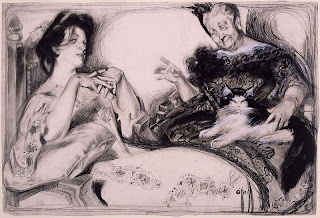
Signs by Rosie O'Neill.
Mass
Think Rodin, JC Leyendecker or Rose O'Neill.

Texture
It makes things and people seem real.

Symbolism
Personal, classical, mystical or cultural - words, numbers, objects, beings. There's no shortage of sources or end to interpretation as Michael Kaluta and Brian Despain are good examples.

Synecdoche  (Micro defining Macro)
A small area of tight or implied detail will help define vast shapes - like the windows in a colossal building or the wrinkles on an elephant. One needs the wee bits for versimilitude...

Ornament
Whether it's Mary Engelbreit's checkerboards, or Stephen Hickman's ornate orientalism, Ornament matters. Sometimes it's a sort of texture, other times the whole raison d'etre.

Narrative
Is there a story here? A big idea? A paradigm, a parody, a pastiche? Has the sword been nicked in battle, has the dog been fed, has the sweater been patched? Norman Rockwell began his pictures thinking of a soldier under a light post and ran scenarios in his mind (often switching "lead" characters) until he found a painting.

Juxtaposition
Comparisons and contrasts of size, scope, meaning, characters... in our world of Zoroastrian black and white contrasts, this is often too-easy. Use discretion and variety.

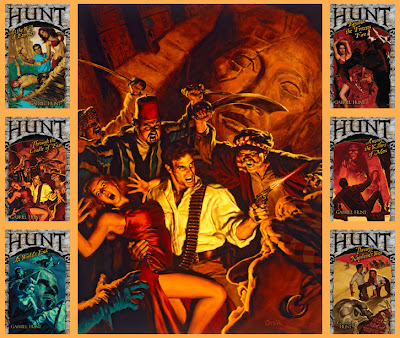
Hunt for Adventure art by Glenn Orbik


Stylization
Sometimes it's fetishism for a type of brush-stroke or color scheme, sometimes caricature or anatomy. For example, the best pin-ups (by Gil Elvgren, Aly Fell, Glen Orbik, et alia) have similarly stylized elements, some of which might surprise you.
If you're working on a pin-up, just crack their code and you're off to the races.

Character
Have the characters lived real lives? Are they real beings with hopes and fears? Body language, gesture and costume are crucial here.

Tension
Gesture is important, but so is the feeling of tension. Sometimes it's the most important part of a piece. Drama, high stakes, suspense. If you can enlist the viewer's sympathy support or curiosity, you win.

Line
It's quite obvious in the works of Franklin Booth, Aubrey Beardsley, and Mike Mignola - but don't underestimate its importance for Drew Struzan, Arthur Rackham or John Jude Palencar.

Research/Reference
I know precious few people who draw brilliantly out of their heads, but those heads have absorbed the lessons their eyes have shown them for many years. Most of us have been nowhere near as observant, and while we may remember and be able to imagine many things, there are usually areas where we fall down. Bolster yourself and your work with reference. Don't stick slavishly to it, but make it do your bidding.

Vignette
The play of shape (whether silhouette or fully rendered form) against a white, colour, or fully realized background is so important for keeping a viewer interested.

Perspective
Each point in perspective applies to a single dimension (in 2 point perspective the points are nearly always width and depth). Get perspective right and you'll be halfway home. Also, the more you keep you POV away from a normal grid as seen from 6', the more dynamic your piece will be.

FUN!
A certain joie de vivre is key. It doesn't matter if you paint supplely or with technical perfection - If you don't bring some fun and adventure to your work, viewers can tell. They won't always know what's wrong, but they'll get that something is...

To which list the delightful Kurt Huggins suggested:

Process: This is your way of managing and editing all of these different elements. Each step of your process should be about solidifying one more element of the image, building up to a final piece. There are many processes, and many ways to finish, but I think most processes start with idea or composition.

• More of Lee's work at www.leemoyer.com

• Read our interview with Lee Moyer

This article © 2008 Lee Moyer. Used here with permission

Friday, 5 November 2010

Sci-Fi Art Now Creator Interview: Lee Moyer

Inspired by the 20th century's great illustrators and the glories of Art Nouveau, Art Deco, Arts & Crafts, propaganda art and the Pre-Raphaelites, Lee Moyer tailors his work to the specific needs and tastes of his clientele. He excels in art direction, design, collaboration, and illustration - whether classical, vintage, modern, or post-modern.

Embracing digital media in 1989, Lee, whose clients include Paramount Pictures, Sony Pictures, Hasbro and Dark Horse comics, swiftly learned to mix traditional and digital painting seamlessly. He spent a decade as a Docent & Naturalist Illustrator at the Smithsonian Museum of Natural History. The New York Times nominated his work for a Webby in 1999 and his work has featured in Spectrum 12 - 17, Communication Arts, Design Graphics Magazine, D’Artiste - Digital Painting and at the Smithsonian Institution and the National Zoo.

He lives in Portland, Oregon with his talented photographer wife Annaliese and their dog Lego. He also designs games, sculpts, writes, performs, and plays a mean game of Scrabble.

Sci-Fi Art Now: What tools do you mainly use to create your art?

Lee Moyer: Although I've used most every medium known to man over the course of my chequered career - from ink to Scraperboard, carved wood to Sculpy, Oil to Watercolor, Bryce to Groboto - Pencil and Photoshop predominate these days,

Sci-Fi Art Now: Why?

Lee: Ease of use, plasticity. Some media are deeply unforgiving of error (watercolour, oil paint), but since we only get better by making mistakes, I want to use media that encourage and reward mistakes. And there's never been anything as powerful for that as Photoshop.


Sci-Fi Art Now: What inspired you to become an artist?

Lee: The stunning black and white illustrations of John R. Neill in L. Frank Baum's OZ books; the amazing paintings of NC Wyeth, Norman Rockwell and Maxfield Parrish; the surrealism and psychedelia of Rene Magritte, Yellow Submarine and The Point; the beauty and majesty of Night on Bald Mountain (my first encounter with the work of Kay Nielsen) and the other classic Disney films.

Sci-Fi Art Now: What was the most useful piece of advice you were given when you began learning your craft?

Lee: It was probably all the people telling me to do something else. You can't really tell someone to be stubborn and brave and work blindly to an unseen goal. All you can do is make them angrier and more stubborn.... (laughs)

Sci-Fi Art Now: Which artists most inspire you?

Lee: So, so many. My friends Michael Kaluta, Paul Komoda, Steve Hickman, Dawn Wilson, Adam Gillespie, and the late Dave Stevens. Then there's Heinrich Kley, Holling Clancy Holling, Gustav Dore, Rembrandt, Phil Hale, MC Escher, Jaime Hernandez, David Trampier, Kyle Baker, Steve Purcell, Henry Clews Jr., Nicholas Roerich, Winsor McCay, Edd Cartier, Virgil Finlay, Arthur Rackham, Joseph Cornell, Robert McGinness, Richard Amsel, George Petty, Todd Schorr, Antonio Gaudi, Nicolai Fechin, Gil Elvgren, Brian Bolland, Yoshitoshi, Yoshitaka Amano, Bill Watterson... I could go on for days.

Sci-Fi Art Now: What is the appeal to you of science fiction as an inspiration for some of your work?

Lee: It's the best of both worlds. I love making things that no one has ever made before, and making things using the tropes and in the styles of previous SF artists.

Sci-Fi Art Now: Do you have a favourite piece of work or project you have worked on?

Lee: My favourites change pretty often, but the piece that comes to mind is the Art Nouveau poster commissioned by the brilliant bassist Melissa Auf der Maur (from Hole and Smashing Pumpkins).

Sci-Fi Art Now: In your career, have you had any bizarre experiences while creating your art?

I was drawing a portrait of a desert nomad (a la Dune) when I accidentally dropped a greasy piece of pizza on the paper, forming a peculiarly wonderful pattern which I accented with a pencil line. When it was sold in an art show the media were listed as "pencil & pizza grease". Years later, the buyers of the piece brought it to me so that I could outline the concentric "rings" of grease as they spread further across the nomad's cloak.

Sci-Fi Art Now: What most frustrates you about being an artist?

Lee: I love people, but my work demands I forego their company.

Sci-Fi Art Now: What keeps you going despite the hopefully occasional frustrations?

Lee: I love the challenge, the problem-solving, the possibility that someone somewhere will be as inspired by my work as I was by the work of so many that came before me. It's fun. And besides, I have no other viable skills. (laughs)

Sci-Fi Art Now: What advice would you offer to anyone starting out as an artist?

Lee: It's humbling, low-status and all-too-often unrewarding, so do it only if you must!

That said, if you must, study the work of everyone around you. Learn the why of their work, not just the how. Practice is key.

• Check out more of Lee's work at www.leemoyer.com

• Lee has written his personal guide on creating good art, which we have published here with his permission.
Related Posts Plugin for WordPress, Blogger...