Showing posts with label SciFi Art Now. Show all posts

Monday, 4 October 2010

Sci-Fi Art Now Creator Interview: Tim Perkins

A stunning double page spread from Tim Perkins Worlds End


Tim Perkins is comic and concept artist, designer and writer who I've known since my days at Marvel UK, back when I was editing Doctor Who Magazine and Tim was inking pencil art by John Ridgway (who also features in SciFi Art Now)...


SciFi Art Now: Tell us a little bit about yourself and some of the work you have done.


Tim Perkins: I'm an international comic and concept artist, designer and writer based in the UK. I'm married to Margaret with two grown children, my daughter, Joanne, who recently married the love of her life, Toby and my son, Simon. We have several pets, including a little Yorkshire terrier, Bentley “Bogtrotter”, who spends pretty much every hour with me, at my side. He even has his own Twitter page.

As a comic artist and writer I have had the privilege of working on comic characters as diverse as Superman, Batman, Spider-Man, Transformers, Thundercats, Doctor Who, Judge Dredd and Postman Pat, for such illustrious giants as Marvel Comics, DC Comics, 2000AD, Defiant, Tekno, Fleetway and IPC, amongst a great many others.

As a graphic and product designer, my work has been seen in print and merchandising since 1980 for innumerable clients and as a concept artist and designer my work can be seen around the world in a great many theme parks from the UK, through Kazakhstan to the Middle East.

As a concept, storyboard, story, layout, background and colour key artist, designer and writer my work has also been used as inspiration for film and TV projects.

Nowadays my work is split between working on projects for my own publishing and merchandising company, Wizards Keep Limited, lecturing, and commercial commissions. My current work in progress is my graphic novel series; Worlds End – Volume 1 – The Riders on the Storm

SciFi Art Now: What tools do you mainly use to create your art?


Tim: I still work traditionally when drawing and use 0.5 and 0.7 mechanical pencils using blue Pentel leads. For inking, I use Pro Arte “Acrlix” Series 202 brushes, usually sizes 1 & 5; Rexel pen nibs (Ref: 1068A) and Hunt mapping pens (Ref: 9407); and Faber Castell PITT artist pens sizes S, F, M, and B

I rarely use Rapidiograph pens anymore, preferring to use permanent, fine line, marker pens to rule borders and the like. I use Higgins "Black Magic" ink.

For painting, I use all manner of brushes, although have a small set of those, which I use all the time. Paints I use are:Artist Quality Windsor & Newton Watercolour paints (for Watercolours), Windsor & Newton "Galleria" Acrylic paints and Liquitex Acrylic paints (for Acrylics) and for oils, Windsor & Newton Artists Quality Oil Colour paints.

Software wise, I use CS2 suite (Photoshop, etc) for graphic design and some of the early production methods, like flat colours and some SFX and Corel Painter IX more for the painterly effects.

I am using an oversize A4 Wacom Intuos2 stylus and tablet these days - the work area is 210mm squared. I've had it for at least six, or seven years now and wonder how I achieved anything previously working, as I did, with a mouse, not a stylus.

SciFi Art Now: What prompted your current choice of production method?

Tim: I didn't start to look at using computers until 1994 when I bought my first one, which was inadequate for producing artwork on, but which enabled me to train myself to use a computer.

The switch to using computers for graphic design and also the start of my producing colour art on them as well occurred in 2000, when I first started work at Morpheus Animations. I saw the market shifting towards more digital content and found I needed to begin working digitally to work for certain publishers.

By the time I had come to terms with this, I found I had made the switch, with commercial work, at least, to digital art, although I still draw traditionally in pencil even today.

[There is a lot more information in on Tim's FAQs section on his website].

SciFi Art Now: What inspired you to become an artist?

Worlds End by Tim Perkins
Tim: I suppose there have been a lot of influences from within my family as a young child, which in hindsight would inevitably have meant there was a big chance of my following comic art and stories as a career route. My parents both read stories to me and invented new ones too, as did my Grandpa Perkins.

My Uncle Bob used to draw cartoons of the family and stuff with me when I was a kid and my Uncle George was also able to spin out a yarn, or two, so the storytelling has always been present in my life in one way, or another.

The fact my Mum and Dad were so influential in my seeing so many annuals and childrens books and especially my Dad with comic books early on in my life again meant it was inevitable they would have a major influence on my career choice.

I am told that even as a really little child, I was always drawing and some of my earliest memories are of both drawing and reading the books and comics from back then.

I started to notice there was one guy whose work I always liked the best and that was Jack Kirby and his influence is still with me, as far as layout and storytelling is concerned, if only subconsciously.

Jack’s work had it all for me, power, majesty, movement, dynamism, humour, happiness, sadness, and a cosmic all-awareness, as well as a sense of wonder and inquisitiveness and most of all fun!

There's no mistaking the Kirby language and nuances in both his artwork and his prose too. The instant you see a Kirby work there is no doubt it is his. His trees, his rocks, his water, his castles, his characters and their garb, along with everything he drew are his alone and bigger and craggier than life and yet so symbolic in their depiction, almost like a shorthand. His Kirby Krackle adorns all manner of cosmically powered SFX and his people ooze with sheer power.

There followed other artistic and literary influences, many of which are in my Hall of Fame on the website, as I continued to soak up the creativity of a great many different writers and artists like a sponge, something I continue to do even now. I just love looking at all the wonderful artwork and stories out there.

SciFi Art Now: What was the most useful piece of advice you were given when you began learning your craft?

Tim: [Comics artist] John Ridgway is probably the most influential in his advice to me early on in my career. He took great pains to help me look at my work and hone my storytelling skills. I have always seemed to have a knack for creating off the cuff, and/or with a word, title, or phrase and that is something John continued with me, as far as storytelling is concerned. If anything he certainly made me look at as many different ways to do something as possible. It is something which has stayed with me and something I try to pass on to my students on the Fantasy Art Unlimited course.

Big Barda penciled by Jack Kirby,
inks by Mike Royer
SciFi Art Now: Which artists most inspire you?

Tim: As I have said Jack Kirby was the biggest influence followed by the guys in my Hall of Fame, like Barry Windsor Smith, Will Eisner, Nestor Redondo et al and John Ridgway and a great many others, such as John Buscema, Bernie Wrightson, Frank Bellamy, Richard Corben, Joe Sinnott, Gene Colan, Gil Kane, Mike Noble etc.

Even guys today wow me with their stuff and that for me is an important thing - not to lose that spark to be able to appreciate all manner of different styles and techniques for what they are and enjoy them to the hilt.

Then there are the SciFi artists like Roger Dean, Rodney Matthews, Peter Jones, Chris Foss, Patrick Woodroffe, Bruce Pennington, Melvyn Grant and John Harris, amongst others, whose work cannot but inspire and has done so for me since I was in my teens.

I guess for me it's the quality of work I am looking at and inspired by, the sheer level of craftsmanship and draughtsmanship achieved, as well as the level of storytelling, whether that is sequential, or a single image.
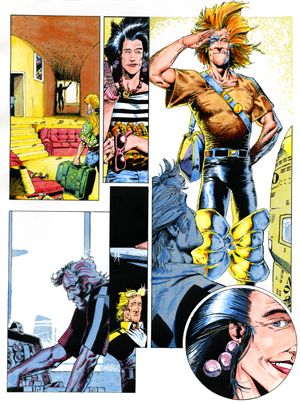
Chopper for 2000AD. Pencils and inks by
Colin MacNeil, painted by Tim
SciFi Art Now: What is the appeal to you of science fiction as an inspiration for some of your work?

Tim: For me, Science Fiction and Fantasy have always been the very best ways of telling stories which although futuristic in one way, or another, reflect the world we live in today with all its many facets and fears and joys and celebrations. In comics the stories which I loved the most were always based in SciFi, which is why when I was chosen to be a part of this book amongst the fantastic line up of very talented creative folks, I was so pleased.

I've always loved the work I have been involved with the most when it was a SciFi story.

It is with that in mind that I guess I have always tried to pick up work with some kind of ScFi element in the stories. It hasn’t always been possible, but that brings me to Wizards Keep, which I set up for this very reason, so I had a vehicle with which to both tell my stories and create the art for them, without the obvious publishing and editorial corporate constraints I had experienced before doing so.

My latest work in progress, which will be completed in the next few months is my Worlds End graphic novel, which I am billing as a Science Fusion book, crossing SciFi with Fantasy elements, a kind of Star Wars meets Lord of the Rings.

This has been an absolute dream for me to able to produce and is the first time I feel I have really been able to show what I can do. It has afforded me the privilege to be able to draw some of the many wonderful scenes floating around inside my head for all these years. Epic Vistas inspired by the spirit of SciFi.

SciFi inspires people of all ages and of both sexes in many different ways. Scifi has certainly played its part in moulding me as a creative person and I hope my new work can continue in that fashion and inspire a new generation of folks, as well as those already in love with the genre.

SciFi Art Now: Do you have a favourite piece of work or project you have worked on?
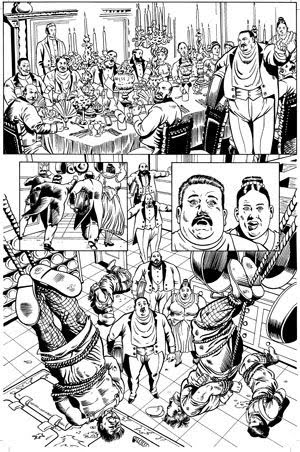
Phage - Shadow Death
Tim: The best work of my career is certainly my latest, Worlds End and has sated many desires I have had to produce work of this kind. I have been a part of a lot of SciFi storylines before, such as all the 2000AD work, like Judge Dredd, Rogue Trooper, Universal Soldier, Chopper, Junker, Zippy Couriers, and Shadows, etc and Open Spaces for Marvel Comics, Plasma and War Dancer for Defiant, and Phage – Shadow Death for Tekno, but never with the full control to do what I have with my new work.

Worlds End has enabled me to show my storytelling skills as well as my artistic and design skills alongside a totally focussed vision of the worlds playing out their parts in the story. It is the first time I have fully took on the roles of world creating in every way, something I have not been able to do working as a team player amongst others whereby you are playing out someone else’s ideas, fantasies and dreamscapes.

I have been able to control every aspect of design and story playing the parts of concept artist, designer, script writer, lighting engineer, costume designer, makeup artist, casting director, voice coach, product/craft/prop designer, and planetary world builder, again a first for me in publishing.

I thought I would share the opening words of the story - This is how the saga begins:

“On the third planet from the outer rim of the Squatsretch system lies a world untainted by evil. its myriad inhabitants going about their daily lives without worry or fear…”

“That is until today…”

The basic premise is of an entire civilisation's invasion fleet infesting a small, quiet, unassuming planet intent on Terra-forming it and it is up to a small band of misplaced characters to stop them. The fate of a world lies in the hands of a wizard, his familiar, a young boy, a girl and the mystery of Worlds End. Are they enough to stop the myriad forces from the depths of outer space...?

I am having great fun with the characters and their stories and the response from fans and pros alike has been wonderful and I cannot wait to see it in their hands for real.

SciFi Art Now: In your career, have you had any bizarre experiences while creating your art?

Tim: When we first moved house some years ago I was working in another of the rooms at the back of the house, at the time, and I had left the front door open to unload the car and bring in some stuff I had been out to buy. This took me a few minutes to do.

Upon entering the studio I heard something shuffling about at the back of the room, behind the drawing board. I popped my head around and startled a large grey cat, which had obviously sought refuge whilst I had the front door open.

In turn it startled me as it leapt out from behind the board, leaping first across the fax machine I was using back then, deleting the messages I had not yet listened to. It then scrambled across my drawing board, which sported my artwork for the comic I was working on at the time, entitled Traffic and sent the Bristol boards sprawling across the floor of the studio, before leaping to the top of the stairs.

It left in a hurry, helped in kind by my own efforts to eject its evil form from the premises. The only thought as I returned to the studio was exactly that of remembering what I had read of Roger Dean and his cat experience! [Some of the clouds in one of the Yessongs album inside cover picture are actually reworked paw prints caused when the artist's cat walked across a drying painting. One paw print is still clearly visible in the final painting - Ed]

Luckily, when I looked at the pages, despite having walked all over them, the pages were quite okay, to my relief, but I never found out who it had been that had contacted me and left the messages.

Although I have seen the cat since, strangely enough, he has not repaid the visit.

SciFi Art Now: What most frustrates you about being an artist?

Tim: I can’t really say I am frustrated as an artist, as I love what I do and feel very privileged to have been able to pursue a career as I have in this way working alongside some of the most talented people in the world.

I suppose if I do have slight peeves with being an artist the first is the constraints placed on you as an artist, but I understand the reasons when you are working with the Intellectual Properties of corporate companies.

Another is the search for the ever elusive perfect illustration and story, which I doubt I will ever achieve, but then that is also part of the fun trying to arrive at that particular destination.

SciFi Art Now: What keeps you going despite the hopefully occasional frustrations?

Tim: It's the absolute need and not a desire to produce work. When I am not being creative I find myself being creative in my thoughts. You just can’t switch off being creative; it’s a big part of who I am.

In another, more practical way, there's the simple fact that we earn money through our work and like all folks that survive in this world through an ability to earn a living in some way, so too we earn money in this same way – in other words we can either work and earn money, or else starve.

That is not even a thought with me on a personal level though and I cannot think of myself not doing what I do, so I suppose life and my family and friends and this wonderful world and the vast, uncharted universe full, as it is, of its many and varied wonders are the things that inspire me.

Who could not be inspired by a world in which we see three suns and a myriad planets in the skies, and where the ships sail upon methane oceans, whist the hulls are bombarded by sulphuric acid rain.

I hope from the above sentence that you can hopefully see that Worlds End will be FUN-filled!

SciFi Art Now: What advice would you offer to anyone starting out as an artist?

Tim: I always pretty much say the same things: Draw, Draw, Draw, and then Draw some more.

The only way to continually hone your drawing skills is to practice all the time. I still sketch all the time and I have worked professionally now since 1980. I know a lot of guys in the field and they all continually draw all the time. You can never draw too much. Absorb as much information as you can. Study from as many "How to" books and other sources like museums and comics and photographs, etc, as you can. Art courses can always help.

Try to remember these five simple rules and you will be part way to achieving your goal:

Learn from everyone and realise no one has all the answers, we all have pieces of a jigsaw that when put together are greater as a whole. Study lots of different artist' work in lots of styles.

Copy no one else, but find yourself by learning how many different people work and develop your style over time with the amassed knowledge. Try to imitate these styles, not to merely copy them, but to try to understand how a particular look or effect is achieved by other artists and begin to develop your own style. This will always shine through in time.

Look for things, which repeat in both positive and negative connotations and through these reoccurrences find things to both embrace and things to avoid at all cost.

Be willing to bend, but not break, a lot of what we do is down to compromise and team play, not ego. That said be true to yourself when it matters, this is easier to do with experience under your belt.

Work hard – seriously be prepared to work harder than you can imagine and be willing to sacrifice a lot of your personal “normal” time to producing artwork and/or stories. For every minute you spend doing so you get closer to the goal of being good enough to work as a professional. For every minute you neglect to do so, someone else is doing exactly that and now stands above you in the line up to the publisher’s doors.

Most of all, however, practise, practice, practice.

Again, there's more information on the website and I am always willing to discuss things in more depth and help students via email. Folks just need to realise that this can only be done within the time frame that I am free to do so, with work permitting and it may take time to receive answers and comments, but rest assured your patience will pay off dividends and I will get in touch as soon as I can.

SciFi Art Now: Tim, thanks very much for your time and answers to our questions.

• Tim is an official guest at the Malta Comic Convention 2 Website in October

• Tim's Official Web Site: www.wizards-keep.com


• Tim's Official www.wizards-keep.blogspot.com


• Contact Tim via: tim@wizards-keep.com

• Mail can be sent to Tim Perkins c/o Wizards Keep Limited, 11 Walton Crescent, Blackburn, Lancashire BB2 3TQ UK

Wednesday, 29 September 2010

Sci-Fi Art Now really isn't this expensive to buy...

Artist John Malcolm came across a copy of SciFi Art Now being offered on Amazon.co.uk.

We'd just like to assure those waiting for the book to come out that it really isn't this expensive...

Monday, 27 September 2010

Sci-Fi Art Now Creator Interview: Jeff Michelmann

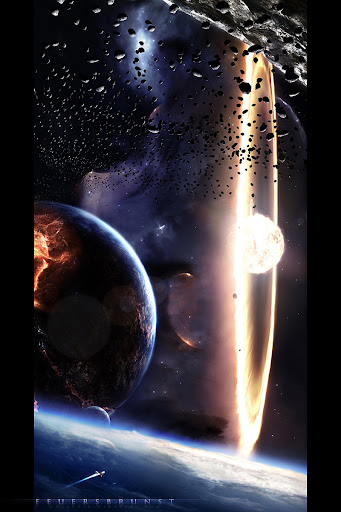
Feuersbrunst
by Jeff Michelmann
Jeff Michelmann (aka 'Gucken') is a young self-taught artist living in Germany. Space Art is his favourite kind of art - much of are scenes happening in space or on fictional planets in unknown galaxies...

SciFi Art Now: What tools do you mainly use to create your art?

Jeff Michlmann: When it comes to traditional art, which I hardly do anymore, I mainly use pencils of all kind. Most of the time I'm sitting in front of Photoshop CS3 together with my Wacom Intuos3 A5.

SciFi Art Now: Why?

Jeff: I'd love to use Painter some time, but I never got my hands on it. But, then again, Photoshop is all I need -- Photoshop and a Wacom, of course!

SciFi Art Now: What inspired you to become an artist?

Jeff: It all began with an online multi-player space simulator called Freelancer... Oh, it was classic...

SciFi Art Now: What was the most useful piece of advice you were given when you began learning your craft?

Jeff: The funny thing is, that it wasn't advice that was given to me directly. I learned it through different ways like watching others paint, hearing their stories about life and so on. But the main thing that was stuck in my head for all these years, which I'll never forget, is to never give up!

SciFi Art Now: Which artists most inspire you?

Jeff: There are way too many. But the one artist that inspired me and helped me the most is Tobias Roetsch. We are big buddies, constantly helping each other out and inspiring one another.. without him, I wouldn't be where I am right now.

Another big artist who majorly inspired me was is Bobby Chiu. His first video podcasts really helped me a lot in the past.

There are many more artists who inspired me in the past and still continue on inspiring me with their art -- Greg Martin, Gary Tonge and Dylan Cole come into my mind, but there are lots more that I can't add right here, as the list would go on forever.

SciFi Art Now: What is the appeal to you of science fiction as an inspiration for some of your work?

Jeff: Oh, science fiction is a brilliant genre! The best thing about it, is that you can go crazy with your ideas. However this applies to any other genre, of course, fantasy or surreal art for example. So, what I love about science fiction in particular, is the futuristic setting, which sets it apart from any other genre, in my opinion.
The combination of different genres is always icing on the cake. Surreal space art,.. Robots in a fantasy world.. That's something that I haven't seen that much of lately.

SciFi Art Now: Do you have a favourite piece of work or project you have worked on?

Jeff: I really enjoyed working on my latest landscape scene called 'First Sunshine'. It took me a lot of time to complete that work, which I hardly even realised, as time just flew by.

First_Sunshine by Jeff Michelmann
Working on my latest space art, 'Polaris'  was much fun, as well. It's the second version of an old piece I created four years ago and I was able to see the progress I have made during that time by comparing both versions.

SciFi Art Now: In your career, have you had any bizarre experiences while creating your art?

Jeff: Well, not really. Except for  the computer crashing on me once and for all out of the blue, but that's happened to so many digital artists before, so it isn't really bizarre anymore.

SciFi Art Now: What most frustrates you about being an artist?

Jeff: This is an easy one! My own mind and perception. It can't be any more frustrating, when a project just won't work out the way you want it to, and you constantly think that everything you try to paint is bad due to a temporary low.

SciFi Art Now: What keeps you going, despite the hopefully occasional frustrations?

Jeff: Every time this happens, I say to myself that this is only one more step to being a better artist. Every brush stroke I make, will help me on my way. After all, everyone has to start somewhere, and all I have to do is keep on practising -- and  keep on painting.

The_Observer
by Jeff Michelmann
SciFi Art Now: What advice would you offer to anyone starting out as an artist?

Jeff: I think this is rather obvious and very cliché, but.. don't give up, practise makes perfect.

• Check out Jeff's work at: www.GTGraphics.de or on the brilliant DeviantArt web site at: http://gucken.deviantart.com

• To contact Jeff email him via j.michelmanngtgraphics.de

Monday, 20 September 2010

Sci-Fi Art Now Creator Interview: Mo Ali

Wind Farm by Mo Ali

The format of SciFi Art Now - out this October - is such that it promotes the art of the creators, but there's not much room to tell you more about them and their work. We're publishing interviews with creators here to redress the balance.

Artist, poet and writer Mo Ali lives in the south-east of England, which really doesn't help. His recent work has included pin-up art for the graphic novel Wolfmen 2: Fall of the Wolfmen by Dave West and Andy Bloor, artwork for the BBC News website and cover work for the novel Crown Wearer written by William Couper...


SciFi Art Now: What tools do you mainly use to create your art?

Mo Ali: It depends on the specifics of a project or piece, but good old pencil and paper usually, followed with digital tools like Photoshop. But I try not to limit myself to any one tool.

SciFi Art Now: Why?

Mo: It's just the way that works for me and, in terms of not limiting the tools you use, it keeps you flexible and adaptable, and can result in something different and unique every time.

Wolfmen by Mo Ali
SciFi Art Now: What inspired you to become an artist?

Mo: Honestly, I'm not sure. It could have been from watching cartoons and art shows as a kid, reading comics and books and admiring the covers and artwork inside, and wanting to be able to create stuff like that. There wasn't a lightbulb moment of revelation though.

SciFi Art Now: What was the most useful piece of advice you were given when you began learning your craft?

Mo: That there is no 'right way' or style when it comes to creating art...and also to practice, practice, practice.

SciFi Art Now: Which artists most inspire you?

Mo: I don't know about 'most inspire', but I like art by Dave McKean, Frank Quitely, Moebius, surrealist painter Yves Tanguy, Lierre Foest, David Lloyd, Lubna Agha, Klark Kent... it's a constantly evolving list though.

SciFi Art Now: What is the appeal to you of science fiction as an inspiration for some of your work?

Mo: I think it's because, at its best, science-fiction can combine the fantastical with the very real in interesting ways that engage the imagination. And because of the robots. Obviously.

A portrait of cult author Jeff Lint,
writer of such classics as Jelly Result
and The Stupid Conversation.
Illustrated from a now-lost
photograph of the author
circa-1990.


A bio of Lint, written by Steve
Aylett can be found here at
www.steveaylett.com/Pages
/LINTpage.html
SciFi Art Now: Do you have a favourite piece of work or project you have worked on?

Mo: Alas, I'm too self-critical to have a favourite, but I recently did a portrait sketch of cult SF author Jeff Lint which turned out rather nice.

SciFi Art Now: In your career, have you had any bizarre experiences while creating your art?

Mo: Sadly no, all the bizarre stuff just happens in my head. Its probably better that way.

SciFi Art Now: What most frustrates you about being an artist?

Mo: That I'm not able to draw or paint exactly what I imagine in my mind. I'm accepting it over time, but it still annoys me.

SciFi Art Now: What keeps you going despite the hopefully occasional frustrations?

Mo: That one day soon I'll draw something I'm happy with.

SciFi Art Now: What advice would you offer to anyone starting out as an artist?

The cover of the novel
Crown Wearer
written
by William Couper

Art: Mo Ali
Mo: Copy, trace, mimic and learn from other artists. Copying isn't bad, its part of the learning process.

And also practice, practice, practice.

• For more of Mo's work visit: www.moali.co.uk. To cotact Mo email: infoATmoali.co.uk

Monday, 30 August 2010

Sci-Fi Art Now Creator Interview: Nemons

The format of SciFi Art Now - out this October - is such that it promotes the art of the creators, but there's not much room to tell you more about them and their work. We're publishing interviews with creators here to redress the balance.

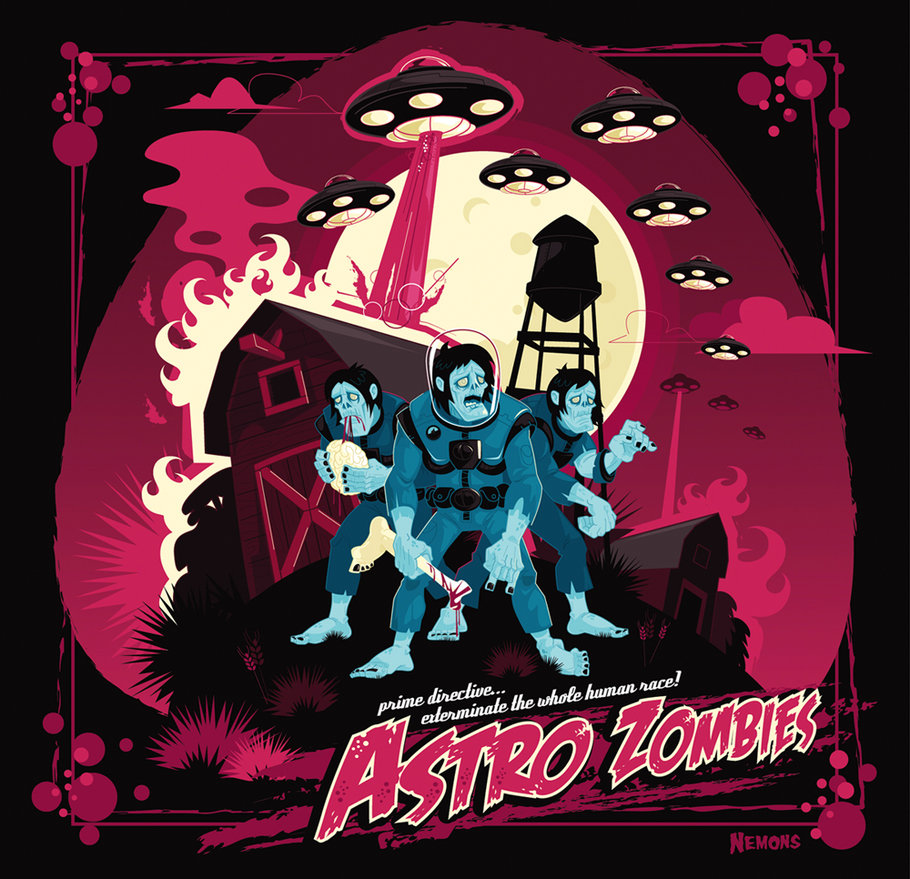
Gary Hall (aka Nemons) has worked in the games industry as a commercial artist for over 10 years creating characters, concepts, logos, user interfaces and more for companies such as Sony, EA, Microsoft, SEGA and Activision. 

Now he's trying to establish himself in his own right in his own way, more of which can be seen on his official web site...


SciFi Art Now: What tools do you mainly use to create your art?

Gary Hall: Pencil, paper, scanner and my iMac!

SciFi Art Now: Why?

Astro Zombies by Gary Hall
Gary: I like the crispness I can achieve by using a computer and it let's me adapt my work for different media

SciFi Art Now: What inspired you to become an artist?

Gary: Reading Asterix, TinTin and 2000AD and watching Disney films and other animations, I used to spend endless hours copying my favourite characters and covers.

SciFi Art Now: What was the most useful piece of advice you were given when you began learning your craft?

Gary: Don't give up! practice, practice, practice...

Durham Red from the UK comic 2000AD
Homage by Gary Hall
SciFi Art Now: Which artists most inspire you?

Gary: Albert Uderzo, Disney and Pixar, Saul Bass, Chris Foss, HR Giger, Aubrey Beardsley, James Jarvis, Junko Mizuno - I could go on and on!

SciFi Art Now: What is the appeal to you of science fiction as an inspiration for some of your work?

Gary: I love retro sci-fi and b-movie horror films, the monsters, heroes and girls are just fantastic - the 1950's and 60's was the golden age of these type of films and their posters really inspire me. Men were real heroes, women were fainting femme fatales and one-eyed martian killer cyborgs were one-eyed martian killer cyborgs!

SciFi Art Now: Do you have a favourite piece of work or project you have worked on?

Gary: I'm never satisfied with anything I do! I guess it's a built in survival system to make me create more work :)

SciFi Art Now: In your career, have you had any bizarre experiences while creating your art?

Gary: I have so many bizarre experiences on a daily basis it's nice that they don't happen when I'm drawing.

SciFi Art Now: What most frustrates you about being an artist?

Gary: that the world and his dog are expert art critics and never let a moment go by to tell you "what you've done wrong" or "what they would have done"

SciFi Art Now: What keeps you going despite the hopefully occasional frustrations?

Gary: "Why stop now just when I'm hating it" - Marvin!

SciFi Art Now: What advice would you offer to anyone starting out as an artist?

Gary: Never let anyone stop you drawing what you want to draw! It might not make you rich but it will make you happy.

Web Links

• Check out Gary Hall's web site at: http://nemons.deviantart.com

• Contact Gary via: gary@octopus-ink.co.uk


Monday, 23 August 2010

Sci-Fi Art Now Creator Interview: Duncan Long


Crystal Dragon cover for Asimov's
- featured in SciFi Art Now
The format of SciFi Art Now - out this October - is such that it promotes the art of the creators, but there's not much room to tell you more about them and their work. We're publishing interviews with creators here to redress the balance.

Duncan Long started work as an illustrator/writer in 1985. Since then, he's created over a thousand book and magazine illustrations. As a writer, he's authored 13 novels (for HarperCollins, Avon Books) and 60-plus technical books (Paladin Press, Delta Press, Lyons Press, etc.), and ghostwritten over a dozen titles for radio and TV celebrities. 

SciFiArt Now: Tell us a little bit about yourself and some of the work you have done.

Duncan Long: I've played on both sides of the publishing street, starting as a small publisher in the 1980s, doing the writing and illustration for the books I marketed via mail order. I soon discovered I loved the writing and illustration part but hated the marketing and paperwork, and so graduated to having other publishers handle that stuff.

Over the last decade or so I've migrated toward mostly creating book illustration and only occasionally writing a book or article.

The majority of my illustrations are done for self publishing authors, though I still do some work for larger publishers. Among those I've done work for are HarperCollins, PS Publishing, Pocket Books, Solomon Press, Fort Ross, and Asimov's Science Fiction Magazine.

Currently I'm working on the artwork for John Chadwell's graphic novel Werewolves of New Idria, which is being published by Moonstone Books.

Readers can see my best work online at http://DuncanLong.com/art.html

SciFi Art Now: What tools do you mainly use to create your art?

Duncan: I do all my work digitally, and generally don't even make pencil sketches or the like. Digital is much faster and allows for experimentation on the fly, so it has become the most natural route toward producing artwork. Since most publishers prefer work in digital format and often request changes, this also does away with the need to scan paintings or drawings, colour adjust them, and so forth. Digital from the start is just a whole lot easier and faster.

'Roberto Aceves' by Duncan Long
My hardware is a four-core, memory-crammed PC with a Wacom tablet. Software is generally an old, old version of Corel PhotoPaint 8. I use other software from time to time including Vue. But most of the work is done in PhotoPaint.

SicFi Art Now: What inspired you to become an artist?

Duncan: I have just always loved art and drawing. As a kid I also loved the old science fiction book covers and such, so doing book cover illustrations is pretty much a dream come true for me, and something that seemed like I should be doing from the get go.

SciFi Art Now: What was the most useful piece of advice you were given when you began learning your craft?

Duncan: Actually it came from my music teacher: craftsmanship comes from practice.

You can't just think about making artwork, you have to dive in and make more and more artwork, music, or whatever it is you're intent on doing. Only when your craftsmanship is secure and the mechanics of production second nature, can you be free to realize in your performance what you imagine in your head. Whether you're riding a bike, painting a portrait, or playing the piano, practice is where it's at.

SciFi Art Now: Which artists most inspire you?

Duncan: About any famous artist offers techniques and layout that an illustrator can learn from. A few off-the-top-of-my-head picks: Leonardo Di Vinci, Salvador Dali, Norman Rockwell, and Michael Whelan. But it's a list that might go on and on.

SciFi Art Now: What is the appeal to you of science fiction as an inspiration for some of your work?

Duncan: Science fiction is the melting pot of the arts. You can have a story set in any time past, present, or future; set anywhere from under the sea to deep, unexplored corners of the universe; and with any sort of character from an android wanting to be human to a human becoming a monster. Each new illustration project with a science fiction theme has a potential surprise or two and often will demand new solutions and even techniques to make the picture work.

'Agendas' by Duncan Long
SciFi Art Now: Do you have a favourite piece of work or project you have worked on?

Duncan: This is sort of like asking a parent which child is their favourite! I think My (current - it changes by the day) favorite top five would be "Agendas," "Crystal Dragon" (which appeared as an Asimov's Science Fiction cover), "Down to Earth," "Treehouse Clan," and "Roberto Aceves" (which was concept art for John Chadwell's Werewolves of New Idria).

SciFi Art Now: In your career, have you had any bizarre experiences while creating your art?

Duncan: I think about the only notable thing was my bashing a keyboard apart on the monitor when things weren't going so well (ha). But I generally am pretty patient and easy going (my story notwithstanding) and my life, pretty uneventful. I'll have to try to make up some good stories, ideally involving the exchange of gunfire and a beautiful female model.

SciFi Art Now: What most frustrates you about being an artist?

Duncan: I think the current trend toward artwork by committee. When a project is under the wings of a good art director or seasoned editor, things generally go smoothly because that person has a vision and knows what works and what does not. They explain what they want, pick you because they know you can handle the work, and things are straightforward with results that I can be proud of.

'Treehouse Clan' by Duncan Long
More recently too many of those in the publishing industry seem to have lost their nerve, asking everyone and their cat to make suggestions for changes once the project is underway. When that happens, a project gets jerked this way and that, becoming a great example of the old saw that a camel is a horse designed by a committee.

I have come to call this "death by committee" and it's always sad to see an illustration that had great potential die a slow death from a thousand meaningless changes.

Fortunately those in the industry are growing aware of the problem and hopefully it will soon go back to the practice of having a seasoned and secure art director to pilot the project along to a safe harbour.

[Duncan talks more about this problem here on his ace Book Cover Illustrations blog]

SciFi Art Now: What keeps you going despite the hopefully occasional frustrations?

Duncan: Well, money always helps (ha). However I think the satisfaction of those illustrations that are so marvelous when they're finished that that I have to step back and say, "How in the world did I do that!?" Sometimes it seems like the muse was whispering in the illustrator's ear and the artwork exceeds the ability of the artist. Those are moments of joy and amazement.

SciFi Art Now: What advice would you offer to anyone starting out as an artist?

'Starman Smith' by Duncan Long -
featured in SciFi Art Now
Duncan: Find a style you do well and that you enjoy doing. Art directors and other clients often pick illustrators for a job by the past work the artist has done and by the stuff in the artist's portfolio. If an illustrator isn't careful, he can get locked into doing work he doesn't much enjoy. And, of course, doing something you enjoy always makes the work better and more pleasant to do.

• Check out Duncan's work at: http://DuncanLong.com/art.html

• Bookmark his blog for insights into the publishing industry and his latest work

• Duncan Long's Book Cover Illustrations, Book Cover Art, CD Album Art, Graphic Designs, and Other Graphic Artwork

• Duncan's Free Ebooks and Publications

• Duncan's Digital Music and MP3s

Thursday, 8 April 2010

What is Sci-Fi Art Now?

SciFi Art Now is a book I've edited under the direction of UK publishers ILEX. It will be published in October and features a wide range of art from both established and new artists from across the globe.

Top science fiction artist Chris Foss - whose work influenced my SF book buying back in the 1970s - has very kindly provided the foreword.

Check back here for the latest news about the book, which is scheduled for publication in October 2010 and related articles. I'm hoping to 'spotlight' artists whose work features in the book on this blog, and feature news about them and their work.

ILEX have published a number of "Art Now" books and they've been very well received, including  Fantasy Art Now by Martin McKenna which included fantasy art by the likes of Clint Langley, Greg Staples, Glenn Fabry, James Rayman, Linda Bergkvist, Liam Sharp, Jason Chan, Aly Fell, Aaron Sng and Robert Chang. They followed that up with a recently-released second volume compiled by Ally Fell & Duddlebug, showcasing the latest, cutting-edge fantasy artwork and design.

The Ilex Press has achieved an international reputation as a publisher of high quality illustrated reference books which cover all aspects of creativity and popular culture. The company was formed in January 2000 as a collaborative venture between the directors of The Ivy Press and Alastair Campbell.

Ilex Press books are published under its own imprint, ILEX, throughout the world in the English language (excluding North America), and are distributed in these markets by Thames and Hudson.

In North America, Ilex Press books are sold under various imprints by well-known publishers such as The Reader's Digest, Chronicle Books, Abrams, Harper Collins, Watson Guptill, St Martin's Press, Running Press, and O'Reilly. They're translated into many languages including French, German, Dutch, Spanish, Portuguese, Italian, Polish, Russian, Chinese, Korean, etc.

I'm really excited about this project: although I've worked in publishing for over 20 years - mainly in comics - this is my first book, and I hope it's a success, and helps the artists featured get work.

• Pre-order Sci-Fi Art Now from amazon.comPre-order Sci-Fi Art Now from amazon.com

• Pre-order Sci-Fi Art Now from amazon.co.uk


• More about ILEX at: www.ilex-press.com
Related Posts Plugin for WordPress, Blogger...